


Animals Make the Best Cartoon Characters
Garfield. Snoopy. Mickey Mouse. Donald Duck. Simba. Baloo. Bambi. Dumbo. It's a long list, and it keeps going.
Animals show up again and again in the most recognizable cartoons because they are often more effective storytellers than humans.
In our Electivity cartoon drawing after-school programs, kids get a chance to explore this by sketching their own animal characters.
It works so well because there's a built-in shorthand to animals. You don’t have to explain as much. People already come with assumptions about what a cat is like, or a dog, or a crocodile. The artist can take that and push it further.
We Connect With Animal Characters So Easily
It’s slightly odd, when you think about it, how much emotional weight people place on animal characters.
A lion cub dealing with loss, or a small elephant being laughed at, can sometimes trigger a deeper emotional response than a human character in the same situation.
With a character like Simba, there aren’t many visual cues telling you how to "read" him in a social sense. He isn’t tied to a specific culture or background in the way a human character would be. That leaves more room for the audience to step in and fill the gaps themselves.
Dumbo works in a similar way. The story hinges on being singled out for something you can’t change, but because he isn’t human, the idea travels more freely. It doesn’t feel like it belongs to one group of people.
Human characters don’t always have that same openness. The more specific the design, the more it can narrow who feels included in the story. Animals tend to sidestep that.
They’re Simply Easier to Draw Expressively
There’s also a very practical side to this. Animal features are useful when you’re trying to make something readable at a glance.
Ears, tails, snouts, whiskers—they all give you extra ways to show emotion or attitude without overcomplicating the drawing. A slight change in the angle of a dog’s ears, or the shape of a cat’s eyes, can shift the whole mood.
You can exaggerate animal features quite far and it still feels natural, whereas human faces quickly look "off" if the proportions aren't just right. Garfield is a perfect example—that flat, unimpressed expression works because it captures what we expect from a cat with a sardonic personality.
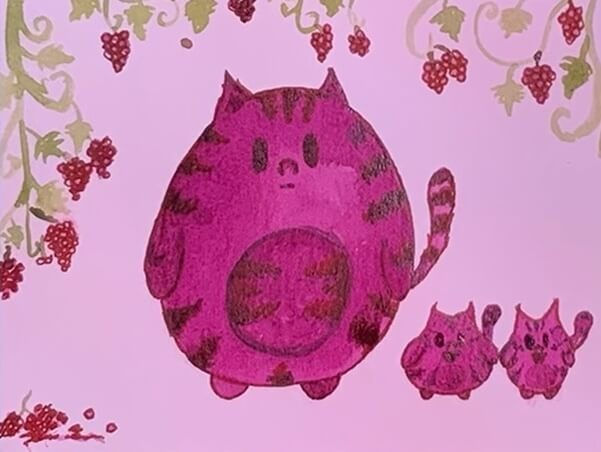
The same goes for color and pattern. A fish can be bright red, green and yellow, and still feel believable within the world of the drawing. A bird can be entirely purple, or a cat magenta, and it doesn’t raise many questions.
The same logic applies to dragons and unicorns—even though they’re made up, they feel 'real' the moment you give them a clear expression.


Kids Tend to Get There First
If you watch how children interact with animals—real or imagined—none of this is particularly surprising.
A stuffed toy quickly becomes a specific character with preferences and moods. The family pet is included in conversations, blamed for things (the dog ate my homework), and given credit for things it definitely didn’t do.
You can see that same imagination in the drawings from our recent sessions—where every animal, from the blobby cow to the grinning cats, seems to have its own backstory.
What All of This Is Really About
Cartooning is sometimes described as simplified drawing, but simplification is just the technique. What it's actually about is deciding what's essential—what's the one thing about this animal you want to put across—and then committing to it.
In our Electivity drawing classes, kids follow this instinct. They already personify animals; the lessons just give them the tools to express it more clearly on paper.
Beyond the drawing itself, it’s a chance for them to slow down and really look at the world around them. There’s a natural confidence that comes with that—taking an idea from their head and making it real on the page. They’re usually having a lot of fun with it too.
For School Administrators & PTA/PTO Boards: If you're thinking about adding cartoon drawing to your school's after-school program, Electivity can handle the logistics—finding and vetting instructors, managing registrations, keeping parents in the loop—so it doesn't land on your staff's plate. Get in touch to find out how it works.
For Parents: If these programs aren't at your school yet, you can actually be the one to start the ball rolling. Mention Electivity to your PTA/PTO or reach out to us directly.

Comments