


Woodworking for Kids: What Makes It a Unique After-School Activity
Woodworking is defined by the rigid nature of the material and the specific tools required to shape it. Here is a breakdown of what children actually experience in these sessions.

Material Constraints and Precision
Wood requires a level of foresight that many other classroom materials do not. If a piece is cut an inch too short, it cannot be patched or stretched; the process must usually begin again.
This physical reality forces children to internalize the "measure twice, cut once" rule through direct experience.
The material also varies in grain, knot density, and hardness. A saw behaves differently depending on the direction of the cut.
To succeed, the student must observe the piece of wood in front of them and adjust their physical approach accordingly. It is a practical problem-solving exercise that requires constant attention.
Developing Tool Literacy
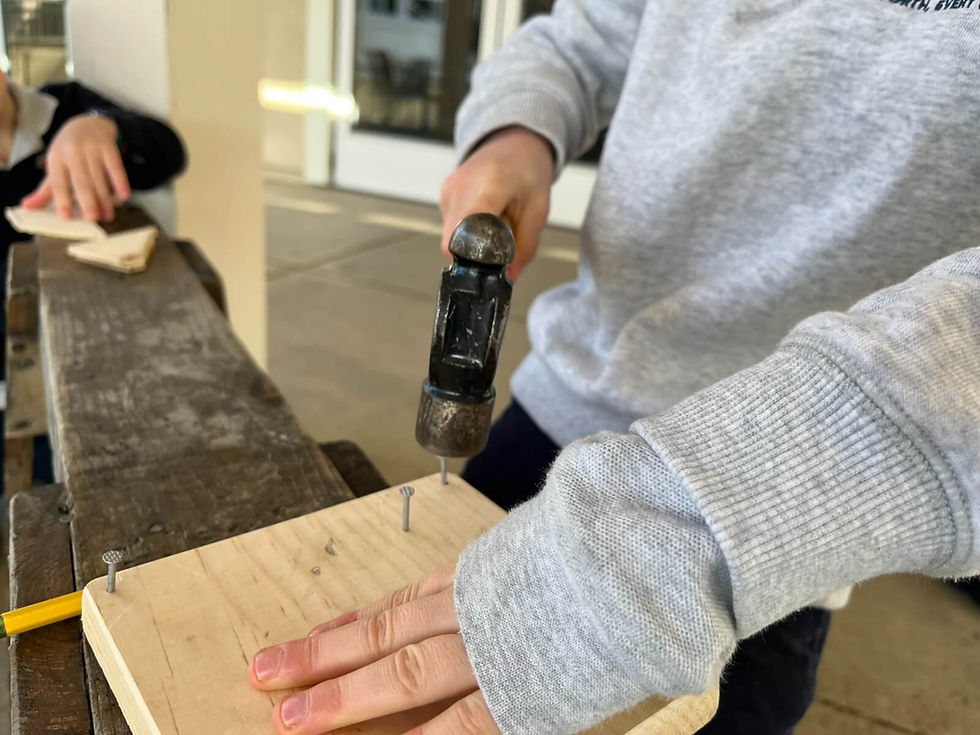
Tool literacy is the ability to select the correct instrument for a task and use it with the proper technique. Children in these programs work with standard hand tools used in professional trades:
Hammers and Screwdrivers: For assembly and mechanical fastening
Hand Saws: For learning control, pacing, and straight-line cutting
Sanding Blocks: For refining surfaces and understanding finishing processes
Using a hand saw, for instance, takes more than finger strength. It involves coordinating the grip, stance, and follow-through of the entire upper body.
These physical demands build dexterity and muscle memory over time.
Safety and Self-Regulation
In a woodworking environment, safety protocols are concrete and the reasons for them are immediate. The students are taught specific habits:
Proper hand placement to keep fingers clear of the saw path
Standard procedures for carrying and handing off tools
Recognizing when a task requires instructor intervention
Because the stakes are real, children tend to self-regulate. These classes are often characterized by a high level of concentration, as the nature of the task demands a quiet, focused approach.
Applied STEM and Problem-Solving
Woodworking serves as a practical application of STEM principles. Every project functions as a real-world engineering challenge where children must measure and calculate dimensions (mathematics) and observe how different materials behave under pressure (science).
When a child identifies why a structure is unstable and implements a fix, they are using the scientific method to problem-solve. This process teaches students to think like engineers and persist through design challenges—skills that are applicable well beyond the workshop.

From Planning to Functional Output
The curriculum follows a linear process: planning, marking, measuring, cutting, joining, sanding, and finishing. Each step is dependent on the quality of the one preceding it.
The finished projects—such as a toy snake, a ship, a magic wand, or a marble game board—are things the kids actually take home and use. That tends to mean more to them than something decorative.


Woodworking Programs via Electivity
Electivity coordinates these woodworking programs for elementary and TK–K children at school campuses. We handle the logistics—instructor sourcing and vetting, parent communication, enrollment—so schools and parents don't have to.
For School Administrators & PTA/PTO Boards:
If you are interested in adding woodworking or other high-quality enrichment programs to your school’s after-school schedule, please contact Electivity. We manage the entire setup process, ensuring a seamless integration with your school’s calendar.
For Parents:
Programs are currently active at select schools for the March–April 2026 session.
If these programs are not yet available at your child's school:
Contact your PTA/PTO or school administration to request they partner with Electivity for future sessions.
Reach out to us directly for more details on our curriculum or to learn how we can help facilitate a program at your location.

Comments